Urgent repairs in NSW rentals: who pays and how fast

Your hot water died last night. It is the middle of winter, the shower is cold, the tenant is upset. Most tenants and most owners do not know that NSW law already answers exactly what happens next. Here is the answer, for both sides of the lease.
What counts as an urgent repair
The Residential Tenancies Act 2010 (NSW) draws a clear line between repairs that can wait for a written request plus a reasonable timeframe and repairs that cannot wait at all. The urgent list includes:
- A burst water service
- A blocked or broken toilet
- A serious roof leak
- A gas leak
- A dangerous electrical fault
- Fire, storm or flood damage
- Failure of an essential service such as hot water, cooking, heating or laundering
- Anything that makes the premises unsafe or insecure
That second-last point is the one that matters on a cold morning. Hot water is an essential service. When the system fails, it is an urgent repair in the eyes of the law, not a job that joins the queue behind a dripping tap.
What a tenant can do
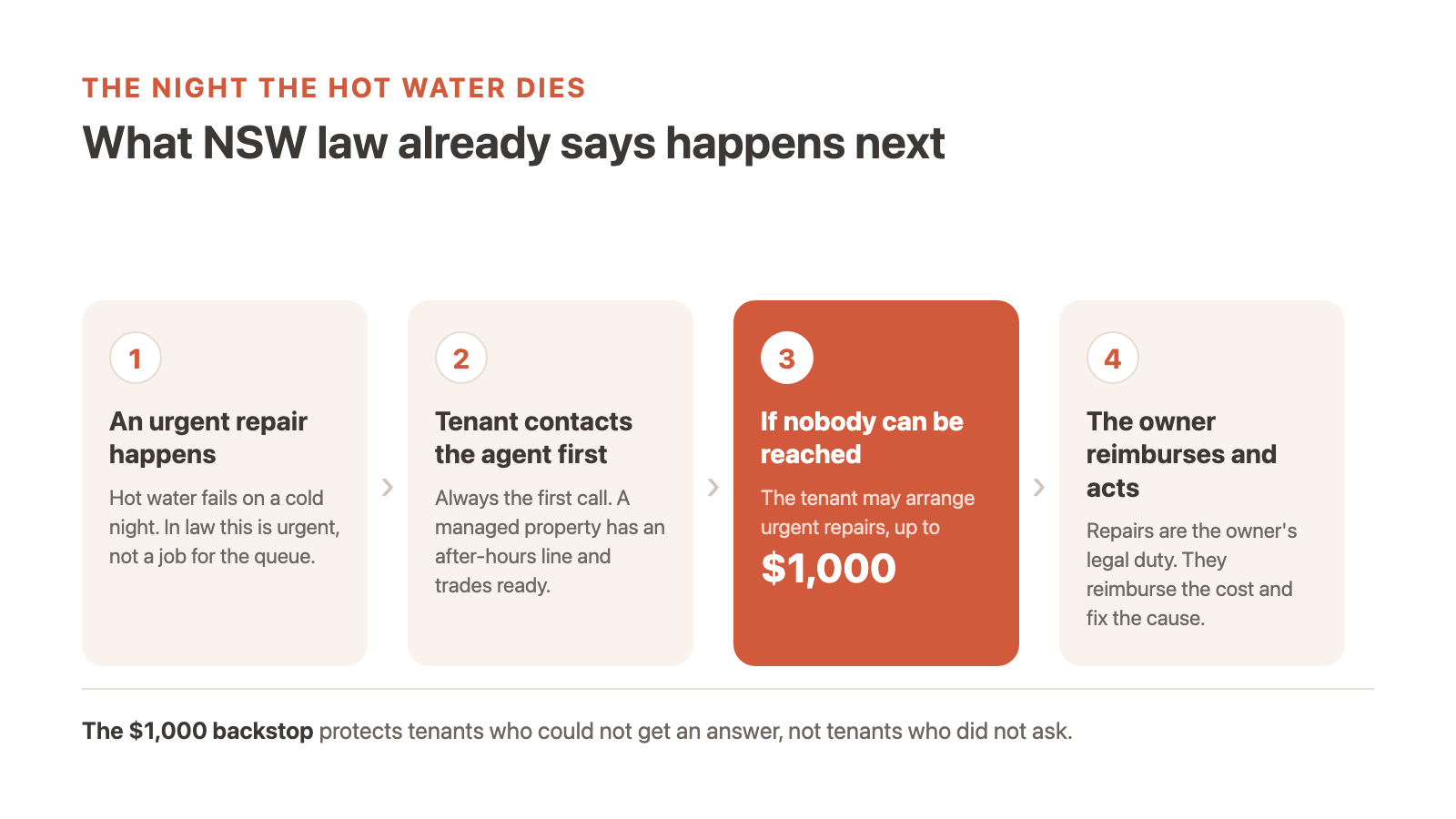
First step, always: contact your property manager or landlord. A managed property should have an after-hours process and trades ready to go, which is faster for everyone than anything the law provides as a backstop.
The backstop exists though. If the landlord or agent cannot be reached, NSW law allows a tenant to arrange urgent repairs themselves, up to $1,000, and seek reimbursement from the owner. That is a legal right, not a courtesy.
Best practice if you ever need to use it: make reasonable attempts to reach the agent or owner first, use a licensed tradesperson, keep every receipt and keep a written record of who you tried to contact and when. The right protects tenants who could not get an answer, not tenants who did not ask.
Not sure how this plays out for your property? A quick call gives you a straight answer.
What an owner must do
Repairs are a legal obligation on the owner. Urgent means urgent, so this is not the moment to gather three quotes over a fortnight. An unresolved repair also has a formal escalation path: the tenant can apply to NCAT for a repair order.
Two practical points sit alongside the obligation. Entry to carry out repairs needs 2 days written notice, but in a genuine emergency no notice is required. And every step should be documented: the report, the trade, the invoice, the fix. If a dispute ever lands at the Tribunal, the owner with the clean written record is in a far stronger position.
Non-urgent repairs work differently
For everything that does not make the urgent list, the process is a written request from the tenant and a reasonable timeframe for the owner to act. Reasonable is not defined to the day, which is exactly why good communication matters. A tenant who hears nothing for three weeks is a tenant heading to Fair Trading's website. If a non-urgent repair is never actioned, NCAT can order it too.
If the hot water dies tonight
- Tenants: call your property manager first, then follow up in writing
- If nobody can be reached, a tenant can arrange urgent repairs up to $1,000 and seek reimbursement
- Use a licensed trade and keep every receipt
- Owners: treat it as urgent, approve the fix quickly and keep records
- Unresolved repairs can end up at NCAT as a repair order
What we handle for you
At The Gallery our tenants know exactly who to call, day or night. We triage the report, send the right trade and keep the owner informed of the problem and the fix in the same update. The $1,000 backstop exists for properties where nobody picks up the phone. Our job is to make sure it is never needed.
A note. This article is general information about NSW tenancy law, not legal advice. Rules change and individual situations differ. Check the current guidance at NSW Fair Trading or seek formal advice before acting.
Want repairs handled before they become disputes?
If you own an investment property and want to know how a well run maintenance process protects you, book a quick call with Thomas and we will walk through it.