What a cheaper agent actually costs

Fees are the easiest thing to compare between agencies, so they are usually the thing owners compare. The problem is that the fee is the one number on the page that is guaranteed and small, while everything it affects is variable and large. Here is a way to work out what an agent is actually costing you. It applies to any agency, including ours.
Comparing fees right now? Our property management fees page runs the same arithmetic with every assumption shown, and we keep it up to date.
Start with what 1% is actually worth
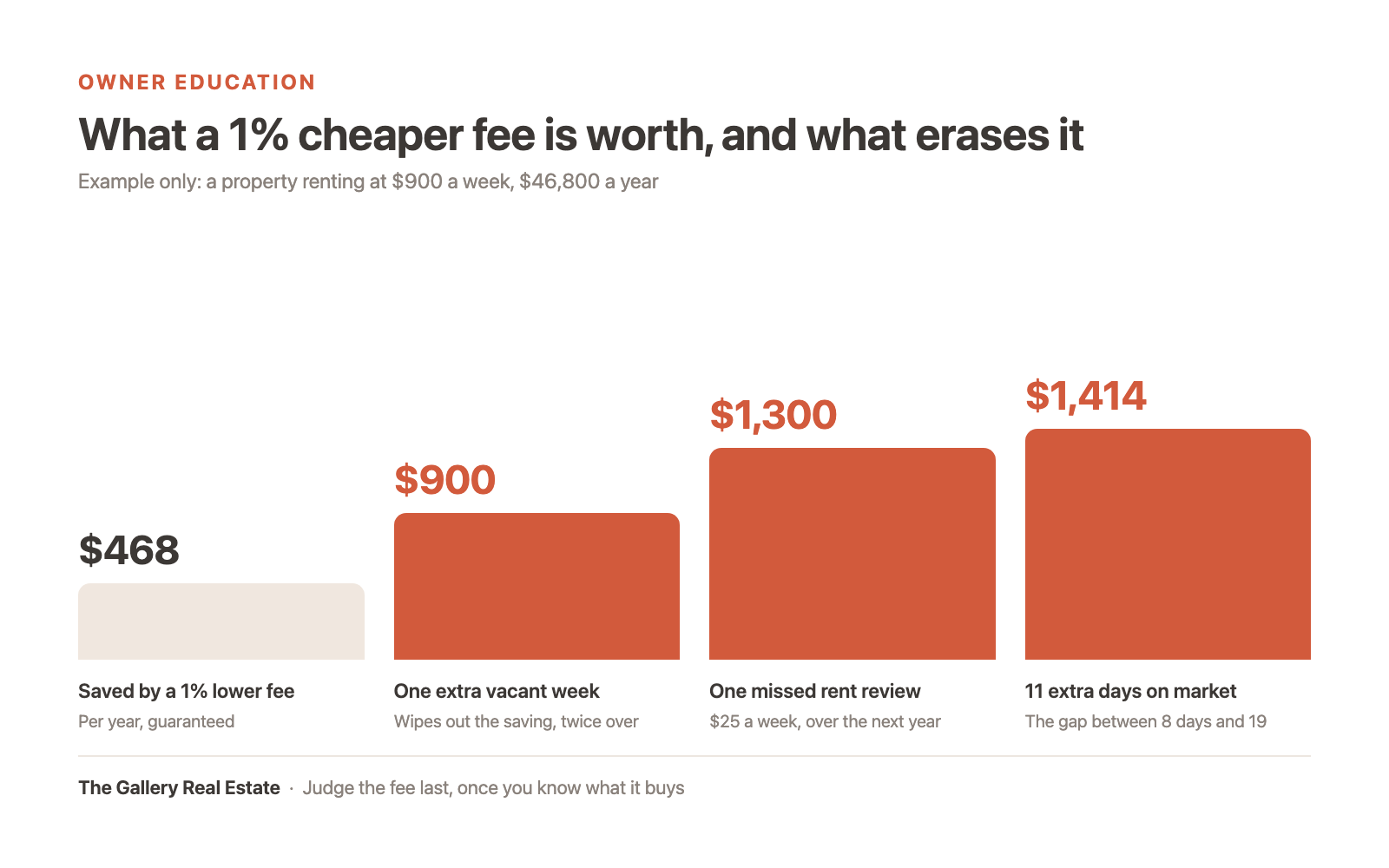
Take a property renting at $900 a week. That is $46,800 a year in gross rent. A management fee 1% lower saves you $468 a year. Two percent lower saves $936.
Those are real savings and worth having. Keep them in your head as the number to beat, because everything below is measured against them.
One vacant week erases it
The same property sitting empty for one extra week costs $900. That is nearly double the annual saving from a 1% cheaper fee, gone in seven days. It happens in the one part of the process an agent most directly controls.
Days on market is where the gap between agencies shows up fastest. Our own average from listing live to leased is 8 days. The wider market median is 19. Whether that gap is 11 days for you or three, the maths works the same way: every week saved is roughly a week's rent kept. Every week lost is a week's rent gone. Against a $468 saving, the margin for error is thin.
This is not an argument for pricing low to lease fast. A property leased quickly to the wrong tenant is more expensive than a slow vacancy. It is an argument for looking at how an agency actually generates enquiry, because that is what turns into speed.
Not sure how this plays out for your property? A quick call gives you a straight answer.
Then there is everything that is harder to see
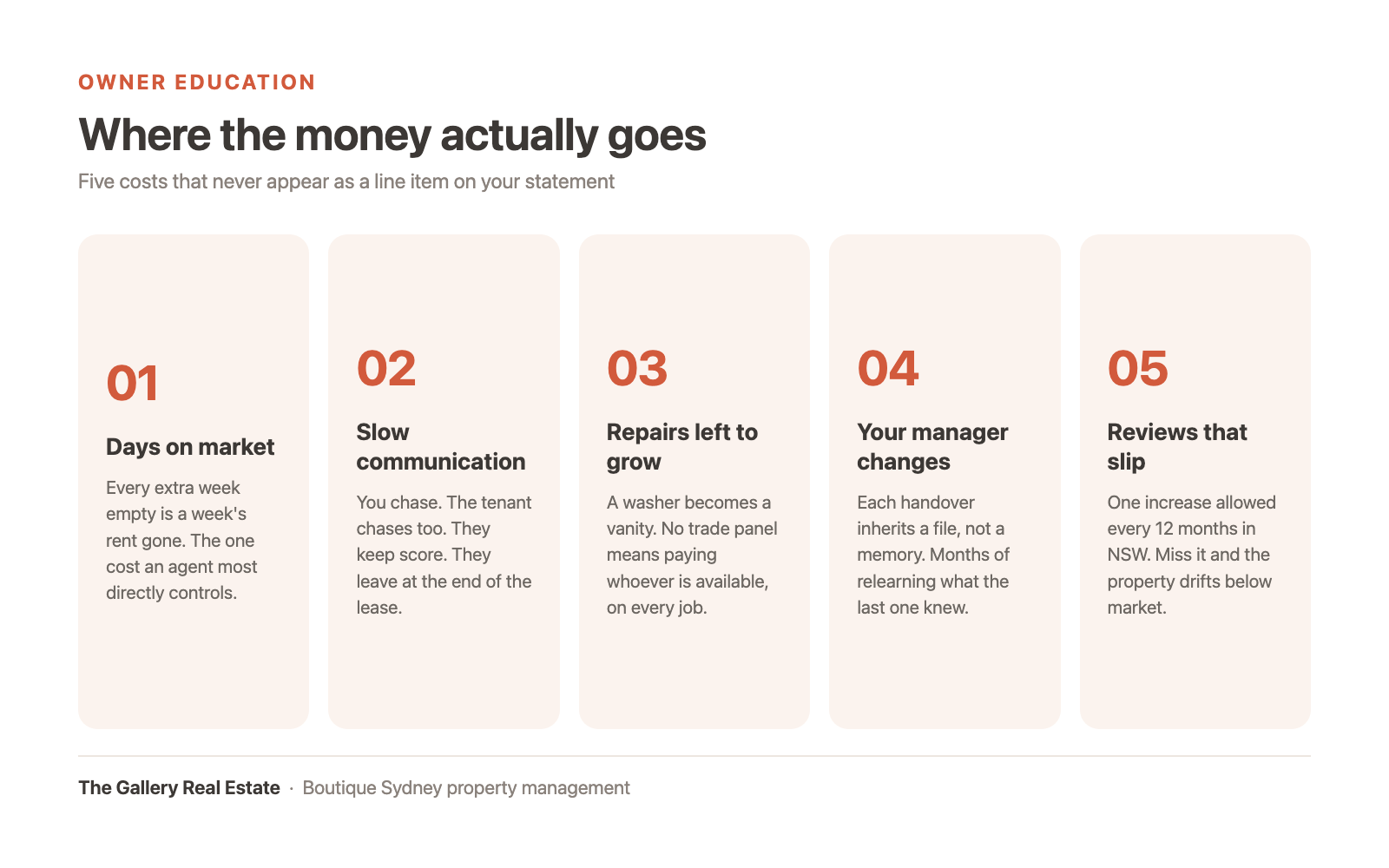
Vacancy is the obvious cost because it shows up as a gap in your statement. The others are quieter. They rarely appear as a line item at all, which is exactly why they are easy to underprice when you are comparing quotes.
Communication that costs you twice
When an agent is slow to respond, two things happen. You spend your own time chasing, which is a cost even if it never appears on an invoice. And the tenant, who is chasing the same agent about the same issue, starts keeping score. Tenants rarely leave over one unanswered email. They leave over a pattern of them. They leave at the end of the lease, which is the most expensive time for you.
A repairs process that lets small things grow
A dripping tap is a washer. Left for three months it is a swollen vanity and a plumber at emergency rates. The difference between the two outcomes is not the plumber, it is whether anyone triaged the job in the first week.
There is a second layer to this. An agency without an established trade panel pays whatever the available trade quotes, because it has no relationship and no volume. You are paying for that on every job, quietly, for as long as you are with them.
Staff changes that reset everything
This is the one owners underestimate most. Property management has high turnover. Each time your manager changes, the new one inherits a file, not a memory. They do not know the tenant is reliable but slow to report things. They do not know the hot water system was patched last winter and is on borrowed time. They do not know you prefer a call before anything over $500.
Every handover costs you a few months of someone learning what the last person already knew. If it happens twice in two years, the property is being managed by a beginner most of the time you are paying for an expert.
Rent reviews that quietly slip
NSW allows one rent increase every 12 months, so each review is a single, scarce opportunity. Miss one $25 a week review and that is $1,300 over the following year, plus every year after it that the property stays behind the market. Two missed reviews and the gap becomes a conversation nobody wants to have with a good tenant who has done nothing wrong.
Put the numbers side by side
On our $900 a week example, a 1% cheaper fee saves $468 a year. Against that, one extra vacant week costs $900. One missed rent review costs about $1,300 over the following year. One tenancy turning over a year early costs a letting fee plus the vacancy plus the wear of a changeover.
You do not need all of those to go wrong. Any single one of them, once, wipes out the saving with room to spare. That is the whole argument. It is just the numbers, not opinion.
How to actually judge an agent
None of this means expensive is good. There are expensive agencies doing a poor job and there are well-run, keenly priced ones. Fee tells you almost nothing on its own, which is why it is a bad first question and a reasonable last one.
These are the questions that tell you something. Ask them of every agency you speak to. Ask them of ours too.
- How many properties does each of your managers look after? Beyond roughly 150 the job becomes triage. Your property competes with everyone else's for attention.
- What is your average days on market? Can you show me the figure? Anyone can quote a number. Ask to see it.
- Who will actually manage my property? How long have they been here? You are hiring a person as much as a business.
- What happens when a repair is reported at 7pm on a Friday? The answer tells you whether there is a process or just good intentions.
- How do you decide when to review my rent? If the answer is that they wait for you to ask, you have found a cost.
- How often will I hear from you when nothing is wrong? Silence is comfortable right up until it isn't.
An agency confident in how it works will answer all six without hesitating. If any answer is vague, that vagueness is the thing you would be buying.
The comparison worth doing
- Work out what 1% of your annual rent actually is, in dollars
- Compare it to one week's rent, then to one missed rent review
- Ask every agency for days on market, then ask to see it
- Ask how many properties your manager personally handles
- Ask who your manager will be and how long they have been there
- Judge the fee last, once you know what it buys
Where we sit on this
We are not the cheapest agency in Sydney and we do not try to be. Managing property is the only thing we do, which means there is no sales department quietly taking priority when something needs attention. Our portfolios are deliberately sized so a manager knows your property rather than processes it.
We also do not publish a blanket fee, because no two owners are in the same situation. A tenanted apartment and a vacant house needing a full lease-up are different pieces of work. Pricing them identically would mean one of you subsidising the other. Tell us about the property and we will put our number in writing, with everything included listed next to it.
If the six questions above get better answers somewhere else, go there. You will still be better off for having asked them.
A note. This article is general information only and the figures are illustrative examples based on a $900 a week property, not a quote or a guarantee. Your own numbers will differ. Fees vary between agencies and between properties.
Want a straight answer on your property?
Send us the address and we will tell you what we would do with it, what we would charge and what you would be getting for it. No obligation either way.